Monday, July 10, 2006

Thanking God for the Little Things

In 1 Thessalonians 5:18, the apostle Paul exhorts the believers;

in everything give thanks; for this is God's will for you in Christ Jesus.
I must confess that I more often fail to give thanks in everything. I find it much easier to complain about this or that rather than seeing the hand of providence. But what really strikes me is that giving thanks in everything implies thanking God for the little things as well. But just what are the little things? Perhaps you may be thinking about things like tap water, refrigerators, or maybe, on a hot day as it is here in Rogers, Arkansas, for air-conditioning. Maybe little things include the variety of foods available in my pantry or even the simple companionship of one of my cats sitting on my lap.

But with all that said, sometimes little things are not as little as we might think. This morning I took my wife into the dentist for her third root canal and crown in about 18 months. At least I can sympathize with the experience having gone through it personally, but while I was out in the lobby working on my laptop, trying to get some work done, my wife was sitting in the dentist chair being worked over. When she comes out from these procedures, her face looks a little beat up. There are the deep creases under her eyes where the glasses they had put on her to protect her eyes had been pressed into her skin by the working of the dentist. My wife has a particularly small mouth making it hard for her to keep it open through the procedure. So, by the end, she is tired, sore and, as I said beat up.

But in the midst of all this, what is it that my wife was thinking about? What were the thoughts that went through her mind as she underwent all this hoopla? Well, after we got home and she could talk a bit more, she made the comment as to how thankful she was for things like Novocain, jaw braces (to hold her mouth open) and a dentist that knew what he was doing. She praised God for these little things that so many in previous generations had to go without during procedures on their teeth. I am not sure, but I believe that 100 years or so ago, the dentist would have given my wife a shot of whiskey and then just pulled that tooth right out. Yes, I too give thanks for the little things that really are not so little.

O Lord, make me ever mindful of the multitude of blessings that are bestowed upon me day by day, even minute by minute. Help me to be a humble child with a thankful heart, always mindful, always contemplating the many things You do for me. May I have the heart of David saying continually, "Many, O LORD my God, are the wonders which You have done, And Your thoughts toward us; There is none to compare with You. If I would declare and speak of them, They would be too numerous to count" (Pslam 40:5).

Let me close with this hymn by Mr. Isaac Watts. In the context of what I have written today, I particularly like the second stanza (which I have bolded):

O bless the Lord, my soul!
Let all within me join,
And aid my tongue to bless His Name
Whose favors are divine.

O bless the Lord, my soul,
Nor let His mercies lie
Forgotten in unthankfulness,
And without praises die.

Tis He forgives thy sins,
Tis He relieves thy pain,
Tis He that heals thy sicknesses
And makes thee young again.

He crowns thy life with love,
When ransomed from the grave;
He that redeemed my soul from hell
Hath sovereign power to save.

He fills the poor with good,
He gives the suff'ers rest;
The Lord hath judgments for the proud,
And justice for th'oppressed.

His wondrous works and ways
He made by Moses known
But sent the world His truth and grace
By His beloved Son.
Soli Deo Gloria,

Pastor Ed

PS - Happy Birthday to my friends (all on July 10th): Rocky Wyatt; Chris Riser and Rebekah Samuelson.

Saturday, July 08, 2006

Why I am a Recent Creationist

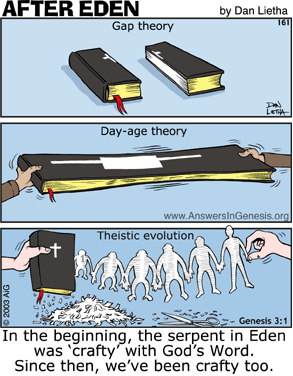
Hey - on a side note - why I am a recent creationist.


Soli Deo Gloria,

Pastor Ed

In View of Your Participation in the Gospel

Yet another brain-numbing day. I have been studying Federal Headship, Imputation, Faith, Repentance, Monergism, and Synergism in preparation for my messages for Sunday. So, for those of you concerned, yes – my mind is still “squishy.”

The day started out with the blessing of men’s prayer breakfast. We had some good food, thanks to Katie W. and proceeded into a good time of prayer and communion with God. Before we prayed, I had the privilege of sharing just a few, nearly random, thoughts concerning Philippians 1:5 –

“in view of your participation in the gospel from the first day
until now.”
I had been dwelling on this verse for the past week, particularly the phrase “your participation in the gospel.” The word for “participation” can also be translated “fellowship” – that is to have in common. This participation on the part of the saints at Philippi was no casual or simply vicarious act. The idea here is that these believers had in common with Paul a vigorous sharing in and of the gospel of Jesus Christ.

This made me question myself, asking, “How do I participate in the gospel?” Perhaps one would think that I have it rather easy in this regard, being a Pastor and all. Of course I participate in the gospel. But, can I hide myself behind my responsibilities at church? Can I so focus upon getting the next lesson done, calling on some members, or even visiting someone in the hospital that I actually fail in participating in the gospel? You see, even in the exercise of “good things” and even “noble things” it is possible to do them for self or even for others and fail to see them done solely and purely for the glory of Jesus Christ.

Also, the tyranny of the urgent, the necessity of getting those things accomplished that seemingly must be accomplished often get in the way of what we, as believers in Christ and those who proclaim the gospel of Jesus Christ, spiritually need to accomplish. I suppose my point is this – I want to be an active, effective and fruitful participant in the gospel of Jesus Christ. I even need to ask myself, “Is the activity I am about to engage in more important, more God-honoring than what He has expressly revealed to me via His Word? I am not suggesting that there is no “fun” time or no “down” time. But my life is to bring glory to God in whatever I do (1 Corinthians 10:31) and so I must be mindful of this in everything I do.

I do not want to be a side-line Christian. I do not want to wait there in fear wondering if the Coach will ever send me into the game. I am a believer in Christ. I am an ambassador o f Christ. I am a witness for Christ. I am in the “game” and need to participate accordingly. I want to fellowship with Christ and with all those who are actively engaged in seeking first the kingdom of God and His righteousness (Matthew 6:33).

How do I participate in the gospel? Humm. How do you participate in the gospel?

Soli Deo Gloria,

Pastor Ed

Friday, July 07, 2006

Repentance and Faith

I have been studying in my office most of the day and occasionally (actually quite often), after multiple hours of such, I find my mind a bit squishy (squishy is a highly technical term for overloaded). Such times are difficult because there usually is still plenty of day left for fruitful exercise and yet the mind is just not working with me.

So, what to do? Many times I will take up the playing and singing of a hymn or praise song. Sometimes, like today, I will simply take out a hymnal (today it was my Gadsby Hymnal) and skim the hymns until I come across a text that catches my attention. I know that does not sound extraordinarily spiritual, but it is the way it often happens. And then, by God's providence, I am, as I said, struck by some hymn text, sometimes just a line or two, that speaks to my heart, challenges my faith, or just causes me the desire of deeper communion with God.

And so, with a mind made squishy from study, I pulled out my Gadsby hymnal and sure enough, I came across a hymn that put into simple terms some of the very things I was studying. You see, I was preparing for my Sunday Evening message on repentance and faith, getting myself a bit bogged down in theological detail, when I read this text by Joseph Hart. I thought on it for some time, appreciating the straight-forwardness of Hart's thoughts, thinking why it is that we don't really have songs being written like this any more?

Faith and repentance are the great honors and privilege of the believer. While they are not solitary means of salvation, for we are saved by Christ alone through His work alone, they are nonetheless an integral part of salvation, absolutely necessary in that they reflect the work of Christ within us. The acts of repentance and faith are the believer's participation with God in the work of salvation, the work being done by God, for even these are said to be gifts from God (Ephesians 2:8; Acts 5:31). Repentance and faith are the outward manifestations and the God-required means by which a person reveals his election, calling, and regeneration from God. As John Murray wrote in his little book, "Redemption, Accomplished and Applied,":

Regeneration is the act of God and of God alone. But faith is not the act of God; it is not God who believes in Christ for salvation, it is the sinner. It is by God's grace that a person is able to believe but faith is an activity on the part of the person and of him alone. In faith we receive and rest upon Christ alone for salvation.

It might be said: this is a strange mixture. God alone regenerates. We alone believe. And we believe in Christ alone for salvation.

This is well stated by Mr. Murray, a seemingly "strange mixture" as God and man "work out salvation" (Philippians 2:12) - noting however that it is ultimately not man working "for" salvation, but working "out" that which God has already wrought within him. We must embrace faith and repentance with eagerness, as they are God's means by which we may know the reality of our salvation. And understand that faith and repentance do not exists separately, as some teach today. There is no such thing, Biblically speaking, as faith without repentance and repentance without faith, or again, as John Murray put it, "penitent faith" and "believing repentance."

Let us be wary of the unorthodox teaching that someone may simply intellectually have faith in Christ as Savior while failing to repent of their sins. There is no faith in Christ as Savior without faith that He is Lord and that as Lord He commands us to "Go and sin no more." Repentance and faith are simply the two sides of the same coin - while distinct they are ever melded together. Anyway, enough commentary. And by the way, if the commentary doesn't make any sense, I will blame it on my squishy mind. Here is the hymn that I read by Joseph Hart:


What various ways do men invent,
To give the conscience ease!
Some say, Believe; and some, Repent;
And some say, Strive to please.

But, brethren, Christ, and Christ alone,
Can rightly do the thing;
Nor ever can the way be known,
Till he salvation bring.

What mean the men that say, Believe.
And let repentance go?
What comfort can the soul receive
That never felt its woe?

Christ says, "That I might sinners call
To penitence, I'm sent;"
And, "Likewise ye shall perish all,
Except ye do repent."

Those who are called by grace divine
Believe, but not alone;
Repentance to their faith they join,
And so go safely on.

But should repentance, or should faith,
Should both deficient seem,
Jesus gives both, the Scripture saith;
Then ask them both of him.


Soli Deo Gloria,

Pastor Ed

Thursday, July 06, 2006

Memorizing Philippians

Yesterday was a rather unique day for me. There was something challenging about studying the Word of God through cold medicines and typing with a messed up pinky finger (see my last post concerning the finger). Through these challenges I have also been working on memorizing Philippians 1 and it is concerning the memorization of the book of Philippians that I write.

As many of you know, we just finished memorizing and quizzing on the book of Titus. When we began the book of Titus, the youth staff knew it would be tough to get all the kids excited about it, particularly because we had so many newer youth who had not experienced it before. Let me tell you, we had our difficulties, yet when it came time to quizzing, something happened that always happens. The kids got excited. And the kids that only memorized half the book or only half-heartedly memorized at all, ended up with a new found commitment to memorize the next book (which happens to be Philippians).

Quiz 06 001 Quiz 06 002

So I write to inform everyone interested that we are not pressing on, committing to memory Philippians. If you happen to be one of the parents of a youth who has been encouraged to memorize – we need your help. We need to ride the wave of their enthusiasm as long as possible. There are two critical time in the memory work process. The first is simply getting started. Often people look at the book and wonder “How will I ever get through it all?” Of course, that why we start with just one chapter at a time. The second stage comes about midway through the memory work. Philippians is a longer book than Titus and the inevitable time will come when they will put off their memory work because it seems like it goes on and on. Please help the youth stick with it. And, on a side note, we do have several adults that are going to work on Philippians as well. Memory work is not only for the youth, but for all the children of God. So please consider memorizing with us (using the NASB 95 update)

Our schedule is as follows:

Philippians Chapter 1 completed by July 31
Philippians Chapter 2 completed by August 31
Philippians Chapter 3 completed by September 20
Philippians 4 completed by October 31.

Quiz 06 003

Our final quiz on the book will be held on Saturday, November 18. Please mark that down on your calendars. There will be monthly quizzes held at the church for each chapter as follows:

Sunday, August 13, 3 pm - Philippians 1
Sunday, September 3, 3 pm – Philippians 2
Sunday, October 1, 3 pm – Philippians 3
Sunday, November 5, 3 pm – Philippians 4
Saturday, November 18, 10 am – 4 pm – Final quiz on the book of Philippians.

Soli Deo Gloria,

Pastor Ed

Wednesday, July 05, 2006

The Day After (the Fourth)

Good Morning!

I begin this day happy and joyful in the Lord, yet still suffering from a head cold, aggravated a bit by the smoke from the fireworks I suppose; and, I am having some trouble typing because I jammed my pinky finger playing football. This is the third finger I have jammed in about 2 months. At least it is a nice shade of blue, red, purple, etc.

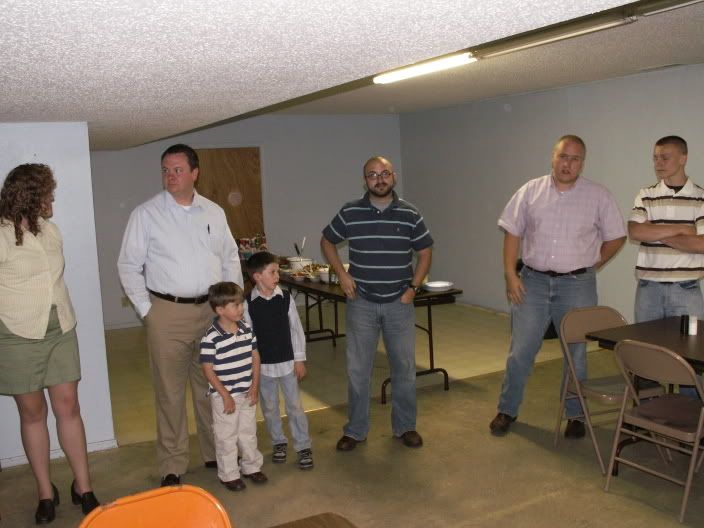
Our church did have a wonderful time last night. We had a great turn out, lots of fun and I personally enjoyed the conversations I had with all. Being still a bit droggy (I hope from the cold medicine), my intention is simply to post some pictures for your enjoyment. You may click on the pictures to see them larger.

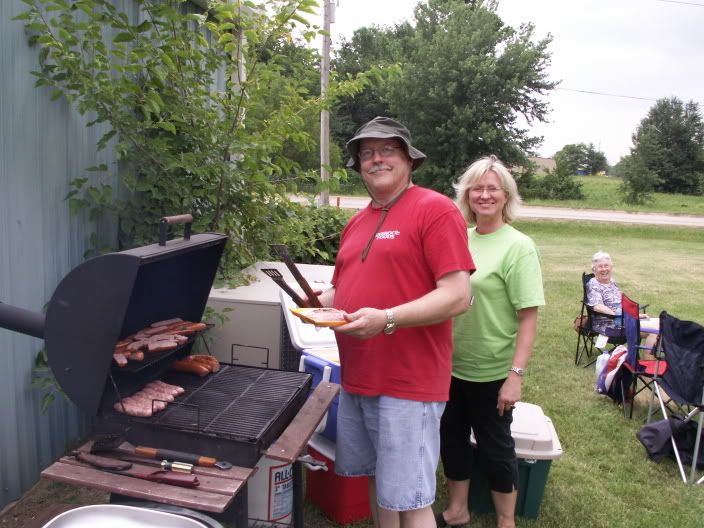
Here is our host and hostest - cooking up the goodies! (along with the goodies):
Jase and Cathy grilling away Are there any calories in these?

Jim and his platform of firework mania:
Jim

And the children:
Ahh relaxing Picture time Can I get messy?

It was so nice to have "superman" drop in on our celebration - don't you think?
HopeCBC's superman

And just some various shots:

Is Lisa trying to fly? Jase and his Pepsi commercial Are we having fun?

Soli Deo Gloria,

Pastor Ed

Tuesday, July 04, 2006

Freedom

This is my second post today. Last Saturday I was listening to Paul Harvey on my way to the church. He began a monologue that I thought was appropriate for consideration as we celebrate our Nation's birthday. My wife transcribed the text from the internet (hope this is legal) and now I offer it for your benefit.

I do offer this one disclaimer - while I am in whole hearted agreement with the sentiment of this monologue, there is a subtle reference to some prosperity theology, which I would not espouse. Be that as it may, please consider these words by Paul Harvey:

In our nation’s Declaration of Independence, have you noticed there is a significant Declaration of Dependence also? Because one without the other won’t work. So our text for today is taken from the next to last sentences in our Nation’s Declaration of Independence. Understand I’m no preacher. The pulpit is a responsibility infinitely higher to any to which I would aspire. I am an historian and inevitably our profession overlap. Our Nation’s Fourth of July celebrations have tended to focus on the word “freedom” and yet, even as our Nation’s founders offered their lives and their fortunes to win for our fledgling nation “freedom” from British rule, in that same eloquent document they sought the guidance and blessings of the Almighty. They appealed to the Supreme Judge of the world for the rectitude of our institutions. “Rectitude,” that’s God’s standard of integrity and honesty.

Our founders proclaimed themselves free to do whatever they want? No, hardly. No, they declared themselves free to do what they ought! There’s a distinct difference. They prayed “Thy Kingdom come, Thy will be done on earth.” They bowed themselves to God’s will and that’s when in an instant ,as historical time is measured, our little 6% of this planet’s population began to accumulate more than half of all of the world’s good things, collecting on God’s written promise that believing on certain things and behaving ourselves, all else would be added. And so it was.

It was only recent generations of Americans mouthing platitudes about “freedom” that obscured the very meaning of the America. And now all over the bleak, black, bloody, front page it is apparent that self government without self discipline won’t work. And you can say that another way, “Capitalism without God is no better than Communism.” The Third Reich was a classic example of capitalism without God. The land which had produced Bach and Beethoven and Brahms ended up producing Auschwitz, Dachau, Buchenwald.

Self government without self discipline won’t work. And today, once free Americans, have to be searched before they can board an airliner, not because there’s a dictator in Washington, but because there’s a handful of irresponsible ingrates running around loose. Because some who are free don’t deserve to be, none of us can be. Again, not because there is tyranny in government but because there is anarchy in the unbuttoned brains of a handful of loony birds.

And it’s down that road of thumbing our noses at rightness and wrongness, it’s down that road that whole nations go from regulation to regimentation then to tyranny. Self government without self discipline won’t work. Much more important than our Nation’s Declaration of Independence from foreign domination is our Nation’s Declaration of Dependence on Divine Providence and sacred honor. You ignore the guidance system that was built into our republic and we are like any unguided missile inevitably destined to self destruct.


Soli Deo Gloria,

Pastor Ed

Pastor Ed's Top Ten

Happy Fourth of July!

My day actually began with a novel activity. I was invited by some of the men in the church to see the movie "Superman Returns." What made this adventure so unique was that we went to see it at 10:20 p.m.! Anyone that knows me, knows what a change of pace that is for me. However, my son, Luke, thought it was great. So, we ushered in our country's birth watching this movie with a overly developed Messiah-complex. Yes, it was visually tantalizing and entertaining, but it also reflected peoples' innate understanding that they need someone from the outside to deliver them from the dark side of human nature - they need a "super" man (what a revelation at 1 a.m. in the morning). Too bad that they look for it in work of fiction rather than from the Word of God, where we learn of the "super" person of Jesus Christ -

John 1:1-4, 14
1 In the beginning was the Word, and the Word was with God, and the Word was God. 2 He was in the beginning with God. 3 All things came into being through Him, and apart from Him nothing came into being that has come into being. 4 In Him was life, and the life was the Light of men...14 And the Word became flesh, and dwelt among us, and we saw His glory, glory as of the only begotten from the Father, full of grace and truth.

Anyway, it was a time of camaraderie.

I thought I would post the ten most influential books (after the Word of God) in my life. I have been giving this some thought over the past few days and let me tell you, it was not as easy as I thought. There are some books that I just knew would be on this list. But then some of the other books, well, I had to really reflect upon how these had impacted or changed me. If you have not read some of these books, I would encourage you to do so. I would also be interested in knowing what books have influenced you. With the exception of the first two books on this list, there is no "rank" of influence per say.

1. The Reformed Doctrine of Predestination (Loraine Boettner)

This book was used by God to bring me into an understanding and love for the Biblical doctrines of grace and a full appreciation of the sovereignty of God in salvation (a.k.a. - Calvinism). I try to read through this book at least once a year. If this title sounds too heady (although I do not consider it an overtly "hard" read) I might suggest a book that served me as a primer for Boettner and this subject (an 11th book in my list) entitled "The Five Points of Calvinism" (Steele, Thomas, Quinn). My original copy of this work was a little booklet that simply and clearly defines and defends the Biblical teaching of God, man and salvation. This work has since been wonderfully updated and is slightly larger than its original print.

2. The Death of Death in the Death of Christ (John Owen)

While I was convinced that the five points of Calvin (TULIP) were really just one point (God's Sovereignty) by the work "The Reformed Doctrine of Predestination" - this work, by one of the premier Puritan scholars, thoroughly explains and defends the case of "Limited Atonement" or "Particular Redemption." Any doubts or concerns regarding my embracing of this doctrine were addressed by this work. This is a "hard" read however, at least it was for me.

3. George Whitefield: God's Anointed Servant in the Great Revival of the Eighteenth Century (Arnold A. Dallimore)

This is a good, straight-forward and easy to read documentation of one of my favorite preachers.

4. The Pilgrim's Progress (John Bunyan)

What list would be complete without this work! Second in influence only to the Bible, yet I am saddened by the fact of how few Christians of our generation have read it. I few years back I went into one of the "Christian" bookstores to pick up a copy for my wife and not only did they not have a copy, but two of the clerks did not even know what it was. When I spoke to the manager, he informed me that they had not carried a copy of the book for some time.

5. Rediscovering Expository Preaching (MacArthur, Master's College Faculty)

This book has influenced me not only in the mechanics of preaching, but also in the great history of preaching, introducing me to several men of the faith whose love for the Word of God has impacted me greatly.

6. A Memoir of the Rev. Edward Payson (Asa Cummings)

Edward Payson was one of the men that MacArthur quoted from in "Rediscovering Expository Preaching." So, I did some research and found this book that contained the journals of this man of God. What a blessing it is to read this book.

7. Distinguishing Traits of Christian Character (Gardner Spring)

This is another author that was introduced to me by MacArthur in a series he preached on Philippians. Both this book and Matthew Mead's, "The Almost Christian Discovered" are challenging to the faith, causing me to examine myself.

8. The Gospel According to Jesus (MacArthur)

Okay, by now you are noticing that MacArthur has influenced me quite a bit. This was the very first JMAC book I read. The Bible College that I attended was in opposition to JMAC's views on "Lordship Salvation." Having read "So Great a Salvation" (Ryrie) and "Absolutely Free" (Hodges), I was determined to read the "other side" and I guess you might say, was converted. What a great work challenging the notion of easy believism and carnal Christianity.

9. Practical Religion (J.C. Ryle)

I just think everyone needs to read this work. This man has a way of opening up the truth of God that is both challenging and comforting.

10. My 1874 leather-bound copy of the Presbyterian Hymnal.

While any good hymnal will do (let me qualify good by saying it has a focus on the sovereignty of God) - I love thumbing through this hymnal in times of devotion and such. If anyone desires to pick up a copy, make sure that it was published prior to 1925 as some gross changes took place in the Presbyterian church at this time that caused them to change some things in this hymnal.

There you have it - my top ten most influential books (and then some). Let me know some of the books that have influenced and helped you. I might need to read them.

Soli Deo Gloria,

Pastor Ed

Monday, July 03, 2006

Considering Isaiah

I would like to say that I woke up all bight-eyed and bushy-taled this morning, but that was not the case. It seems I have attached myself to a pesky summer head cold. I can hardly talk, it hurts to swallow and I feel as though I am walking about in a dreary fog. Yet, in spite of the cold - Praise the Lord!

Our family devotions are taking us through the book of Isaiah right now. Since I was not in a very talkative mood, I made my way to www.monergism.com where I heard would be found a series of mp3's by Mark Dever that outline every book in the Bible; and then have my family listen to his synopsis on Isaiah. Let me tell you, I was not disappointed. Dever offered some wonderful insights and considerations that will help all of us as we continue reading and meditating through this great book.

If it is right to say I had a complaint about Dever's summary (and this is by no means a real complaint) - it would be that there was no real outline of where he was going. To be sure, Dever made wonderful transitions and I could clearly hear where he was going from point to point. However, when I asked my children to tell me what they had heard in some orderly fashion, well, let's just say the fumbled around. So then, I shared with them an outline of what I heard, which seemed to help everyone and so now I share this with you. I might need to go back and listen to the message again to make sure that I did not miss a point, but I gleaned from the message four key points to the book of Isaiah:

First, Isaiah is a book concerning the REBELLION of man; Isaiah begins the book describing the rebellion of Israel and throughout the prophecy reveals the man's rebellion and rejection of God.

Isaiah 1:2-5
2 Listen, O heavens, and hear, O earth; For the LORD speaks, " Sons I have reared and brought up, But they have revolted against Me. 3 "An ox knows its owner, And a donkey its master's manger, But Israel does not know, My people do not understand." 4 Alas, sinful nation, People weighed down with iniquity, Offspring of evildoers, Sons who act corruptly! They have abandoned the LORD, They have despised the Holy One of Israel, They have turned away from Him. 5 Where will you be stricken again, As you continue in your rebellion? The whole head is sick And the whole heart is faint.

Second, Isaiah is a book about the RIGHTEOUSNESS of God. Throughout the book God is reveals as the Sovereign, Providential God who does as He has planned and does what He does in perfect holiness and righteousness. There is none who compare to the majesty, the power, the wonder, the love and the "RIGHT"ness of God.

Isaiah 45:19
"I have not spoken in secret, in some dark land; I did not say to the offspring of Jacob, 'Seek Me in a waste place'; I, the LORD, speak righteousness, declaring things that are upright."

Third, Isaiah presents to us the REMEDY of God for man's sinfulness. Isaiah painstakingly offers forth the prophetic vision of Jesus Christ, the Messiah as the remedy to both Israel's as well as mankind's condition before God. Jesus will be the perfect ruler (Isaiah 9:6) and offer Himself for the spiritual healing of men.

Isaiah 52:7
How lovely on the mountains Are the feet of him who brings good news, Who announces peace And brings good news of happiness, Who announces salvation, And says to Zion, "Your God reigns!"

Isaiah 53:3-5
3 He was despised and forsaken of men, A man of sorrows and acquainted with grief; And like one from whom men hide their face He was despised, and we did not esteem Him. 4 Surely our griefs He Himself bore, And our sorrows He carried; Yet we ourselves esteemed Him stricken, Smitten of God, and afflicted. 5 But He was pierced through for our transgressions, He was crushed for our iniquities; The chastening for our well-being fell upon Him, And by His scourging we are healed.

Finally, the book of Isaiah speaks about the REDEEMED of God - and the redeemed in the book of Isaiah are not merely those of Israel, but all who turn to God.

Isaiah 59:20
"A Redeemer will come to Zion, And to those who turn from transgression in Jacob," declares the LORD."

Isaiah 56:8
The Lord GOD, who gathers the dispersed of Israel, declares, "Yet others I will gather to them, to those already gathered."

Isaiah 63:16
For You are our Father, though Abraham does not know us and Israel does not recognize us. You, O LORD, are our Father, our Redeemer from of old is Your name.

Isaiah 66:2
But to this one I will look, To him who is humble and contrite of spirit, and who trembles at My word.

Isaiah 55:1-11
1 "Ho! Every one who thirsts, come to the waters; And you who have no money come, buy and eat. Come, buy wine and milk Without money and without cost. 2 "Why do you spend money for what is not bread, And your wages for what does not satisfy? Listen carefully to Me, and eat what is good, And delight yourself in abundance. 3 "Inline your ear and come to Me. Listen, that you may live; And I will make an everlasting covenant with you, According to the faithful mercies shown to David. 4 "Behold, I have made him a witness to the peoples, A leader and commander for the peoples. 5 "Behold, you will call a nation you do not know, And a nation which knows you not will run to you, Because of the LORD your God, even the Holy One of Israel; For He has glorified you." 6 Seek the LORD while He may be found; Call upon Him while He is near. 7 Let the wicked forsake his way And the unrighteous man his thoughts; And let him return to the LORD, And He will have compassion on him, And to our God, For He will abundantly pardon. 8 "For My thoughts are not your thoughts, Nor are your ways My ways," declares the LORD. 9 "For as the heavens are higher than the earth, So are My ways higher than your ways And My thoughts than your thoughts. 10 "For as the rain and the snow come down from heaven, And do not return there without watering the earth And making it bear and sprout, And furnishing seed to the sower and bread to the eater; 11 So will My word be which goes forth from My mouth; It will not return to Me empty, Without accomplishing what I desire, And without succeeding in the matter for which I sent it."


If you are interested in listening to some of Dever's book outlines you may find them at - Click Here

Then scroll down to "Courses on Scripture" and look for Dever's Messages.

Soli Deo Gloria,

Pastor Ed

Salad Bar Success

Yesterday the youth hosted a salad bar at the church as a fundraiser for their upcoming camp. Everything was delicious and there was some good times of fellowship and friendship. Also, the youth raised $250 toward camp, which was extremely helpful. For the youth that have participated in all the fundraisers (two car washes and two luncheon bars), they have raised about $100 each toward their $140 camp.

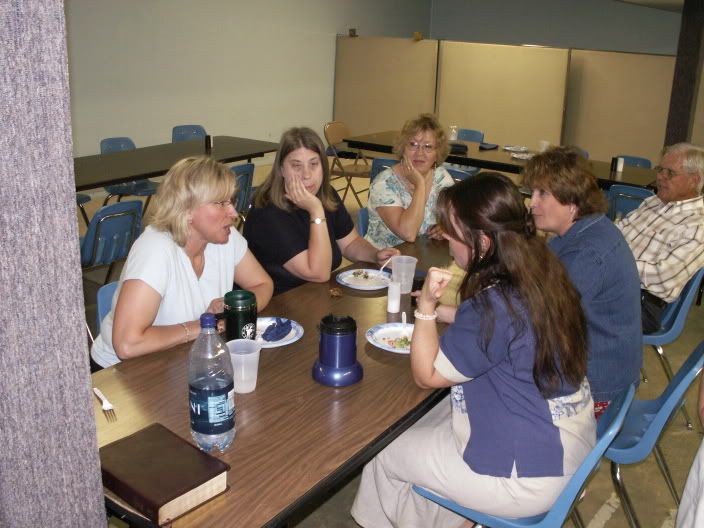
The Youth wish to thank the congregation for their support and generosity. Some were even so generous to give even when they were unable to attend the luncheon. Below are some pictures of the event:

When do we eat? Just Kiddin' Around

Is this my salad? Just visiting
Soli Deo Gloria,

Pastor Ed

Sunday, July 02, 2006

For Whom Did Christ Die? by John Owen (1616-1683)

The Father imposed His wrath due unto, and the Son underwent punishment for, either:

  • All the sins of all men.
  • All the sins of some men, or
  • Some of the sins of all men.

In which case it may be said:

  • That if the last be true, all men have some sins to answer for, and so, none are saved.
  • That if the second be true, then Christ, in their stead suffered for all the sins of all the elect in the whole world, and this is the truth.
  • But if the first be the case, why are not all men free from the punishment due unto their sins?

You answer, "Because of unbelief."

I ask, Is this unbelief a sin, or is it not? If it be, then Christ suffered the punishment due unto it, or He did not. If He did, why must that hinder them more than their other sins for which He died? If He did not, He did not die for all their sins!"

(Adapted from "The Death of Death in the Death of Christ" by John Owen - It was this book that solidified my understanding of "Partiuclar Redemption.")

Soli Deo Gloria,

Pastor Ed

Saturday, July 01, 2006

Another Car Wash Success


I just got back and cleaned up from our latest youth group car wash. Who would of thought that so few people could have so much fun in the 95 degree heat. In reality it was a slow day and one of the least profitable - however, we did make $300 (which is $300 closer to our goal), which works about to about $30 per camper off the price of camp.

In the picture above, Kristina is explaining to Josh the fine art of car washing.


ARE WE HAVING FUN YET? - - - - - - ->

Special thanks to our non-youth group workers, Tina and Mike. We also want to thank Kristina, for even though she will be in Arizona when we have camp, she worked hard.


The theme of this year's camp is officially "No Pride" - but our desire is to talk about the issue of respect; respecting God, respecting the Church, respecting other believers and unbelievers. I am not sure that it went over well, but at one point I challenge the whole group with the question, "If this was Jesus' car, how would you wash it?" At this point many of the youth were hot and tired, so their car washing skills had quickly deteriorated. Of course, this all digressed into a discussion regarding what king of car would Jesus drive - and so the silliness progressed. But we are called to glorify God in the smallest and most mundane of all activities - even in our eating and drinking (1 Corinthians 10:31 - "Whether, then, you eat or drink or whatever you do, do all to the glory of God.")

May God be glorified in our lives, be we eating a sandwich, washing a car, or singing His praises! Amen.

Soli Deo Gloria,

Pastor Ed

A MUST READ!!! - Give Me That Old Time Religion

It is amazing to me as a Pastor to consider how far the modern church has moved away from concepts like true Christian piety as well as what constitutes basic propriety when it comes to the gathering of the saints for the worship of our great God and our Lord Jesus Christ.

There was a time when the saints pursued, as best as they could, absolute purity in thought, word, preparation and deed, particularly as it concerned the meeting of the congregation for worship. Unlike the highly undisciplined ways in which Christians prepare themselves (or do not prepare themselves) for worship and regard the most solemn day of the week, our brothers and sisters of the Puritan church had a uniform and very devout approach to Sunday. Our 24/7 culture and mentality has utterly ruined and obliterated the concept of truly setting aside one day of the week for concentrated focus and attention on our Majesty on High. The result has been a weakening of God’s people and therefore a weakening of the church and the message she is called to proclaim.

In 1644, the reformed Puritan churches created a document entitled A Directory for the Public Worship of God. This document directed the people to consider very practical issues when coming to the place of corporate worship. Although it may seem impractical and impossible today, I fear that if we do not heed the suggestions called for in this work, we will simply continue our weak and pathetic form of Christianity. There may be something to that very “old time religion.” The following is simply an excerpt from one section of this document called “The Sanctification of the Lord’s Day.” Please consider well what is written here. The issues addressed are not a matter of light importance. What is stated here goes to the very core of what we are as the Body of Christ and individually as believers.

I have come to the firm conclusion that much of the problem faced in the church today is due to a continual disregard for those things that reveal a true honor, respect and appreciation to the Lord our God. And, as we lose respect for God, we will most assuredly lose respect for one another and for the lost, to who we are to proclaim the gospel.

I have changed the old spelling of some of the words and have interjected some commentary between each paragraph. The commentary will be indentified by italics so as not to be confused with the document itself, which will be bolded.

Of the Sanctification of the Lord’s Day

The Lord’s Day ought to be so remembered beforehand, as that all worldly business of our ordinary Callings may be so ordered, and so timely and seasonably laid aside, as they may not be impediments to the due sanctifying of the Day when it comes.

We are called to make every preparation necessary to put aside every aspect of worldly life when it comes to the day of corporate worship.

The whole Day is to be celebrated as holy to the Lord, both in public and private, as being the Christian Sabbath. To which end it is requisite, that there be a holy cessation, or resting all the Day, from all unnecessary labors, and abstaining, not only from all sports and pastimes, but also from all worldly words and thoughts.

How often are we more concerned about the football or baseball game? How often do we entertain ourselves with racing, fishing or recreation on the day our hearts and minds are to ponder the vastness and greatness of our God? How often do our conversations reveal that our hearts are more willing to speak of base, temporal and generally evil things, particularly on the Lord’s Day?

That the diet on that Day be so ordered, as that neither servants be unnecessarily detained from the public worship of God, nor any other person hindered from the sanctifying that day.

I have shared the concern with many before of the idea of going out to eat on the Lord’s Day. Why is Sunday such an important day to restaurants? The Christian community, because she is more concerned for herself, her comfort and her gluttonous passion, would rather employ people to feed them than to evangelize them with the gospel. How can we dare give testimony to the priority of Christ in our lives and call others to that priority when, by our own patronizing of food establishments, we are the ones hindering persons from sanctifying the Lord’s Day? I wrestle with this issue greatly. I am not necessarily calling for a complete abstention from such an activity, but at very least I am calling the church to consider well and carefully what it is that we communicate by such actions. I dare say that if the whole of the Christian community abstained from “going out after church” to eat, that many restaurants would at minimum have fewer people working (people who could be encouraged to come to church) or might even have to shut down for some or part of the Day (I know it is a long shot). I do desire that we are thoughtful about what our actions communicate to the unbelieving world.

That there be private preparation of every person or family, by prayer for themselves, and for Gods assistance of the Minister, and for a blessing on his Ministry, and by such holy exercises, as may further dispose them to a more comfortable communion with God in his public Ordinances.

This is simply a call to genuine and concerted prayer for the presentation of the Word of God by the Pastor and that God’s people would be drawn closer in their relationship and love to God through the labors and efforts of the Pastor.

That all the people meet so timely for public worship, that the whole Congregation may be present at the beginning, and with one heart solemnly join together in all parts of the public worship; and not depart till after the Blessing.

Nothing in my mind shows a greater disrespect to God and to God’s people than being late to the worship service. For most of us to show such a complacency or apathy as to be late to work or school would result in our eventual termination or expulsion. If we are so disposed to not make appropriate preparation in this regard, we reveal an utter indifference to God and to His people, particularly those whom He has called to minister to you. To reverse a Biblical phrase, “He who is not faithful in little, will not be faithful in much.” May we be faithful in the little (or not so little) issue of managing our time.

Another concern here is the idea that the worship service has ended with the presentation of the Word of God. Particularly in our church, where there is a concerted effort to discuss and apply the Word of God (a regular practice of the Church in ages past), the worship does not end until the close of our “Fellowship Groups” (i.e. Sunday School). One of the reasons why we do not have our “benediction” until after our “Fellowship Groups” is to place a greater spiritual onus upon each attendee to consider carefully whether or not the activity they are leaving the fellowship for would bring more glory to God than what He has expressly revealed as His will for His people.

That what time is vacant, between, or after the solemn meeting of the Congregation in public, be spent in Reading, Meditation, Repetition of Sermons, (especially, by calling their families to an account of what they have heard) and Catechizing of them, holy conferences, Prayers for a Blessing upon the public Ordinances, singing of Psalms, visiting the sick, relieving the poor, and such like duties of piety, charity, and mercy, accounting the Sabbath a delight.

I was so encouraged by the thought that our brothers and sisters before us were purposely called to repeat the sermon especially by calling the congregation “to an account of what they have heard.” Such an activity was to be done, among other things as listed above, either between meetings or after, but it was to be done for the imparting and applying of God’s truth God’s people. The bottom line is that our goal for our corporate day of worship is to delight in it as an opportunity to fully devote ourselves to God and the tasks He has called us to engage in. In short, our great goal is to “grow in the grace and knowledge of our Lord and Savior Jesus Christ” and we are to make every necessary preparation, sacrifice and labor to ensure that we ourselves, our families, our fellow believers and even as possible those outside the fellowship are taught how to worship, respect and honor the Lord.

Let me know your thoughts. And please, I humbly request that no one view me as seeking legalism. It strikes me as odd that whenever someone simply questions the "status quo" he is quickly dismissed as being legalistic. My desire is to ask ourselves why we do what we do and, does what we do glorify God?

Soli Deo Gloria,

Pastor Ed

Friday, June 30, 2006

Walking in a Manner Worthy - Part 3

I trust that these questions for private devotions have proven to be profitable. I know that they cause me to have much more candid and open conversation with my God (does that mean I am becoming “conversant”?). May the Lord continue to bless us as we pursue conformity to the image of Christ.

As you may notice, I have included all twenty-two questions (without comment) for consideration:


The Twenty-two Questions
George Whitefield and John Wesley AskedThemselves Every Day In Their PrivateDevotions More Than 200 Years Ago.


1. Am I consciously or unconsciously creating the impression than I am better than I really am? In other words, am I a hypocrite?
2. Am I honest in all my acts and words, or do I exaggerate?
3. Do I confidentially pass on to another what I was told to me in confidence?
4. Can I be trusted?
5. Am I a slave to dress, friends, work or habits?
6. Am I self-conscious, self-pitying, or self-justifying?
7. Did the Bible live in me today?
8. Do I give it time to speak to me every day?
9. Am I enjoying prayer?
10. When did I last speak to someone else of my faith?
11. Do I pray about the money I spend?
12. Do I get to bed on time and get up on time?
13. Do I disobey God in anything?
14. Do I insist upon doing something about which my conscience is uneasy?
15. Am I defeated in any part of my life?
16. Am I jealous impure, critical, irritable, touchy or distrusting?
17. How do I spend my spare time?
18. Am I proud?
19. Do I thank God that I am not as other people, especially as the Pharisees who despised the publican?
20. Is there anyone I fear, dislike, disown, criticize, hold a resentment toward or disregard? I If so, what am I doing about it?
21. Do I grumble or complain constantly?
22. Is Christ real to me?

Soli Deo Gloria,

Pastor Ed

Thoughts on the Lord's Supper

As I was preparing my thoughts for our celebration of the Lord's Supper this Sunday, I found myself reading from one of my favorite authors, Edward Payson (thank you John MacArthur for introducing Payson to me via Rediscovering Expository Preaching). I thought I would post these thoughts here for your own preparation before the Table of the Lord.

The Lord’s Table
Edward Payson
Italics – Edward K. Godfrey (at the end)


At the table of our Lord, each of us should recollect the personal favors and marks of kindness which he has himself received from Christ, or through His mediation. Our temporal mercies, our spiritual privileges should all pass in review.

We should look back to the never to be forgotten time of love, when He found us, poor, miserable, wretched, blind and naked; dead in trespasses and sins, having no hope, and without God in the world.

We should remember how He pitied us, awakened us, convinced us of sin, and drew us to Himself by the cords of love.

We should remember how often He has since healed our backslidings, pardoned our sins, borne with our unbelief, ingratitude, and slowness to learn; supplied our wants, listened to our complaints, alleviated our sorrows and revived our drooping spirits when we were ready to faint.

In short, we must remember all the way by which He has led us, these many years, through a wilderness of sins, sorrows, trials and temptations.

Thus we shall be convinced that no sickly infant ever cost his mother a thousandth part of the care, and labor, and suffering which we have cost our Savior; and that no mother has ever shown her infant a thousandth part of the watchful tenderness, which our Savior has shown to us.

This then is forgiveness of sins. This is our redemption. This is our communion with Jesus – that He suffered and died on the cross so that we might remember these things, that we might reflect upon His goodness, that we might rejoice in so great, so wonderful a salvation.

May we partake of the Lord’s Supper together in a manner worthy of our Lord – in a manner that gives to Him all glory and dominion forever and ever. Amen.

Soli Deo Gloria,

Pastor Ed

Thursday, June 29, 2006

Walking in a Manner Worthy - Part 2

Okay, there has been some time to think and contemplate the first questions that Whitefield and Wesley asked themselves in their private devotions. I am not sure why I am stringing these questions out. Someone suggested to me that it was so I would have a consistent line of blog entries. Maybe he was right.

In light of that, I have decided (no I am not going to sing the Amy Grant song) - but I have decided to include more, but not all the questions from the list. I do hope and pray these spark confession and communion with God. I have included some comments in the brackets.

6. Am I self-conscious, self-pitying, or self-justifying?
[ouch - there is way too much of this in me]

7. Did the Bible live in me today?
[let me see?! - oh that I might have a ready answer]

8. Do I give it time to speak to me every day?
[slow down - be still and know that He is God]

9. Am I enjoying prayer?
[Oh yes, Lord, let me rejoice in your presence where there are joys forevermore]

10. When did I last speak to someone else of my faith?
[but I was stuck in my office - Lord, let me be a witness!]

11. Do I pray about the money I spend?
[This does not mean after you spend it]

12. Do I get to bed on time and get up on time?
[Oh how the flesh loves to rest]

13. Do I disobey God in anything?
[NO - said with pride! Oops]

14. Do I insist upon doing something about which my conscience is uneasy?
[Only when I listen to my conscience]

15. Am I defeated in any part of my life?
[Who will deliver me from the body of this death?]

16. Am I jealous impure, critical, irritable, touchy or distrusting?
[Ok, who has been watching?]

I do not mean to be overly light-hearted with my bracketed comments, but these questions are well worth asking often. Let me know how they help you.

Soli Deo Gloria,

Pastor Ed

Wednesday, June 28, 2006

Walking in a Manner Worthy

"Therefore I, the prisoner of the Lord, implore you to walk in a manner worthy of the calling with which you have been called..." (Ephesians 4:1).

Truly one of the more trying aspects of Christianity is self-examination. There is just something about comparing oneself to the perfection of Christ that causes mental anguish – either because one see himself as being truly vile and in desperate need of the grace of Christ, or, on the other side, one see himself as not being “so” bad, thinking that such self-examination unprofitable.

I long to be like Christ and I thank the LORD that this is His ultimate purpose for me (Romans 8:29). But I confess, I need help. I need to be accountable to brothers and sisters in Christ who are likewise committed to sanctification.

One of my heroes of Church History is George Whitefield. So powerful was the ministry of Whitefield that Horatius Bonar made this simple declaration, “Oh, for one day of Whitefield again!” While he was just a man and more precisely, a sinner, Whitefield was a man of passion, endurance and love for the Lord. So, I believe that anything that I might learn and then emulate from this man will draw me closer to Christ. The other day I came across an article entitled simply, “Twenty-two Questions.” These are the questions that Whitefield and Wesley asked themselves every day in their private devotions. It is my intention to post only a handful a day for a couple of days that I (and anyone who reads this) might contemplate them more carefully and fully. May these spark deeper love and devotion to Christ. May these help us identify sinful tendencies in our lives so that we might experience more of the fullness of life and joy that Jesus secured for us (John 10:10).

1. Am I consciously or unconsciously creating the impression than I am better than I really am? In other words, am I a hypocrite?

2. Am I honest in all my acts and words, or do I exaggerate?

3. Do I confidentially pass on to another what I was told to me in confidence?

4. Can I be trusted?

5. Am I a slave to dress, friends, work or habits?


Soli Deo Gloria,

Pastor Ed

Saturday, June 17, 2006

Do not let the sun go down on your anger...

The Lord truly works in mysterious ways, revealing to us the strength of our faith as well as its weaknesses. The other day, as my wife and I were traveling home from Tulsa, we experienced a most unusual occurrence. It was about 9:15 pm and we were less than a half mile from the house when, upon preparing to make a left turn onto the side street, we heard this loud CRACK and THUD, and saw upon the windshield a dizzying spread of GUNK.

At first I had no idea as to what had happened. Because of the way the windshield looked through the GUNK, I could not tell if it was cracked. But then, a realization hit me. As I heard the screams and yells of the little white car that perpetrated the deed, I realized that we had been egged. I had no idea that an egg thrown at a moving car could have such an impact!

Anyway, as I completed the left turn, I looked back to see the little white car speeding off in the other direction. Now, here was my flesh. I could feel a sense of anger welling up inside. I quickly made a turn in the parking lot and sped off to find the eggers! Of course, my thoughts were nothing but noble. I just wanted to tell them of the dangers of throwing objects at moving cars and request of them to clean the car (with their tongues!). But the Lord, in His providence, did not allow me to get far as I lost them, not seeing really where they turned. My wife did ask me what I would have done if I had caught up with them. And while I would like to think I would have handled the situation well, I did have to consider my initial response. To be sure, disappointment and anger at such an act is not in itself wrong. But remember, it was 9:15 pm. The sun had just a few moments left. The words of Ephesians 4:26 sprang up in my head,

"BE ANGRY, AND yet DO NOT SIN; do not let the sun go down on your anger..."

I was running out of sun light and staying angry wasn't going to solve anything. So, we made the final trek home and I washed off the egg from the hood and windshield, noting some minor damage to the paint, but oh well, we were safe. Believing in the providence of God as I do, I began to ask the Lord the lessons I was supposed to learn, handing my sense of vengeance over to the Lord, praying for the salvation of the youth that had nothing better to do and coming to enjoy the rest of the evening.

Soli Deo Gloria,

Pastor Ed

Saturday, June 10, 2006

How to Read

As some of you know, I have long desired to take some kind of speed reading and reading comprehension course. There are so many books, so many issues, and so much to know that I often feel woefully inadequate by way of the information I possess (or lack). Sometimes, feeling this deficiency, I seek to justify not reading more with the classic passage of Ecclesiastes 12:12 -

But beyond this, my son, be warned: the writing of many books is endless, and excessive devotion to books is wearying to the body.

While there may be some of you out there who are execessively devoted to books, I certainly am not. I know that I need to be stretched in this area.

To this end, I was reading Tim Challies blog (http://www.challies.com/) and found a great blog/article on reading. What was most interesting about it is that the few book I have read on speed reading and comprehension were either summarized in this blog or debunked. Now, being somewhat new to the whole blogging world, I am uncertain as to whether what I am about to do is taboo, but for both my benefit and for those who read my blog but might fail to visit http://www.challies.com/, I post the entirety of Mr. Challies article. If I am out of line in doing so, please forgive me and I will make necessary adjustments. I figure that so long as Mr. Challies gets the credit, then I must be in good shape.

So then, consider the following. And if your reading skills needs a push, may this properly stimulate you to greater devotion to reading. Here is Challies on the matter:

As you might imagine, I receive a good deal of email from people who read this site. More often than not I am glad to receive these emails and to respond to them. Communication with readers has proven to be a tremendous challenge and encouragement to me, for which I am exceedingly grateful. Probably the most common questions I receive deal with the subjects of books and reading. It seems that I have established a reputation as a bookworm (which may be justified: I did a Google search on my site this morning for the term "reading." Google turned up 10,700 results) and people often ask just how I find time to read so many books. I thought that today I might share a little bit about how I read as well as why I read and hope it proves interesting and perhaps helpful.

I love to read and have always loved to read. There have been times in life where I have preferred other hobbies, but on the whole reading has been my favorite past-time since I was just a child. When I was younger my parents gave me books by Christian authors like R.C. Sproul and encouraged me to read biographies of great men and women. They modelled a love for reading as both of them constantly read good books. While I chewed on the books they gave me dealing with spiritual topics, I positively devoured books on history, and in particular, military history. My love for this subject took me through university and into adulthood. About four or five years ago, though, I began to be drawn towards Christian books. As far as I can recall, the first of these I bought was Classic Christianity by Bob George and it was soon followed by Ashamed of the Gospel by John MacArthur. That began a trend that has only intensified a the years have gone by.

It was just about three years ago that I decided, mostly on a whim, that I would try to read a book each week for what I hope will be the rest of my life. Subsequently, I also decided that I would attempt to provide reviews of the majority of these books. My reasoning was simply that through these reviews I could help other people who are interested in reading only a few books per year focus on books that are worth their while, while helping them avoid the mountains of trash on the bookstore shelves. My primary inspiration in both reading and reviewing was Gary Gilley of Southern View Chapel and I will always be grateful to him. I realized that if I were to live for another fifty years, this commitment would mean that I would be able to read over 2500 books before I die. The thought of being able to learn from what God has taught 2500 other people was inspiring. Since I set that goal I have found that I can actually read closer to two books every week, so now tend to read and review between 100 and 120 books a year. I suppose this raises the potential to reading over 5,000 books in the next fifty years. I'm going to need some more bookshelves. What follows is some seemingly-random points about reading that you may find helpful.

The more I read, the easier it is to read. A couple of years ago I read four books that discussed godly principles for decision making. Three of them were based primarily on the fourth (and anyone who has read about this subject will know what book I am referring to). Needless to say, it became progressively easier to read and understand each subsequent book. I have found that this is true of any topic. It is also true of reading in general. The more I have dedicated myself to reading, the better I have become at it. I have often spoken to people who have given up on reading because they have found it difficult. To these people I offer this encouragement: press on. Like any discipline, reading will become easier as you dedicate yourself to it.

A lot of the books I read are short. The majority of the books I read are under 250 pages, and quite a few have fewer than 200 pages. I generally do not discriminate against a book based on its page count, so this is either a product of coincidence or of percentages. It seems to me that the average "Christian Living" book weighs in between 160 and 200 pages. Biographies and books dealing with theology or church history tend to be longer and require greater effort.

I read all the time, or most of it anyways. I do not watch all that much TV, but even when I do, I usually have my nose in a book. I also get out of bed a couple of hours before everyone else so I can have some quiet time to read. When I go to the doctor or the barber, I tend to stick a book in my pocket so I can use that fifteen minutes doing something other than reading old copies of People magazine. It is amazing how many ten and fifteen minute periods there are in life that can be used for reading. I realized two Sundays ago that the perfect Sunday afternoon involves being sprawled out on the couch reading systematic theology, sipping on a Coke (with Lime, and in a glass with ice) and having a baseball game (the Toronto Bluejays, of course) on in the background. Life does not get much better.

I do not advocate reading while driving or while operating heavy machinery.

For those who insist that they have no time to read, consider this. If you were to read one page of a book per day, you would be able to read at least two of the average Christian Living books in a year. And, of course, a bathroom break is the perfect time to read a page or two of a book. So consider: if you were to keep a book in the bathroom and read only when you were going to the bathroom, you could read two books per year. If you were to read only when you were brushing your teeth, you could read another book or two a year. So if you feel that you do not have time to read, why not keep a book in the bathroom and commit to reading it there? Here is a good book to keep in the bathroom. [Pastor Ed comment - I have practiced this for years, a great place to read].

One of my peculiarities, but one I have found helpful, is reading two or even three books at a time. I used to find that I would sometimes mistake physical fatigue for what was actually a fatigue brought about by dwelling too long on a particular subject. A perfect example is the biography of William Tyndale I was reading last night. It is a difficult, dense book and I found myself growing very tired as I was reading, even though it was only nine o'clock. When I put it down and began reading a second book, I immediately felt refreshed. My mind was tired and this was making my body feel tired.

I have never been taught how to best read a book. It is entirely conceivable that I do things all wrong. I know there are some excellent books on the topic, but it seems somehow strange to me to read a 500-page book that will teach me how to read a book. Over the past years I have tried a few different methods, some of which have worked and some of which have not. Here is a basic outline of how I read a book.

I begin by giving the book a quick scan, hoping to understand what it is about, what the author is going to attempt to prove and how he is going to set about this task. I read the back cover and the endorsements. I skim over the table of contents and look through the endnotes and bibliography. Having done that, I tend to linger a little bit over the introductory chapter(s), for I find this to be the most important section in the book. It generally lays out the basic framework of the author's argument and lets me know what he is arguing against. I read with a pencil in hand (I buy those clickable Bic pencils by the box) and underline liberally (usually using a Monergism.com bookmark as a ruler). I also tend to jot short notes and questions in the margins or at the end of chapters. Points that are important to the author's argument tend to receive a *, and points that are exceedingly important receive a bigger *. I often also make a list of important page numbers and questions on the inside front cover of the book. In some cases I'll make two or three columns of page numbers. For example, when I was reading Mark Driscoll's Confessions of a Reformission Rev. I found myself writing down the page numbers that contained his best points in one column and the page numbers containing his irreverent, crude points in another. I don't know if there is an objectively good way of marking books, but I doubt it. So work on a system that works for you and stick with it.

This method does not always work. Lately I find myself doing a lot of reading while holding a baby. I can hold a baby and a book, or a pen and a book, but not a baby, pen and book all at the same time. I also tend to spend a lot of time reading while walking the baby in endless circles from the living room to the dining room to the kitchen to the hallway and back to the living room. In such cases I continue reading and try to return later to mark down important points. Looking over the books I have read recently, I can tell which chapters I read while walking the baby as they tend to have far less markings.

I forget a great deal of what I read. Anyone who tells you otherwise may not be telling the truth (unless he has a Spurgeon-like photographic memory). I used to be discouraged if, a year after reading a book, I could barely remember the content. I have since realized that this is inevitable. I focus on remembering what I can and trust that simply because I do not remember the complete outline of a book, this does not prove that a book has not been edifying to me. After all, if this was our standard, every sermon would be a complete failure. I trust that the Spirit works in me as I read good books and that He works despite my imperfect memory.

Reviewing books is an excellent way of driving home the main points of a book. It is as good a memory device as I can imagine. In fact, I would encourage every reader to review the books they read, even if those reviews will never be made public. It is a good discipline to think through the main points of the book and is as valuable a discipline to formulate thoughts on whether or not the reader agrees with a book.

When looking for a good book to read, find a person whose judgment you trust and read what that person is reading. I am collecting lists of recommended books from a wide variety of discerning Christian authors and leaders and will soon post these lists at Discerning Reader. I believe these lists will prove valuable and I am excited to work my way through the books on some of these lists. [Pastor Ed comment - both myself and other pastors I know have had some real problems with Discerning reader in the past. However, Tim Challies has taken over and has no relationship to the former owners. So, I can once again recommend "Discerning Reader" http://www.discerningreader.com/index.php].

Let me wrap it up this way. I see reading as a discipline, but a pleasurable one. I love it and have found it to be tremendously beneficial to my spiritual life. Reading and writing have together brought me untold benefit. I can honestly say that most evenings there is nothing I'd rather do.

Tim Challies - June 8,2006 Blog

I hope you find some helpful encouragement from these words. In short, be consistent; be persistent and keep on reading to the glory of God!

Soli Deo Gloria,

Pastor Ed

Friday, June 09, 2006

Hope and Joy

As mentioned in the previous post, I have been involved in a study that has brought much conviction - reminding me of the solemn and severe duty of being a shepherd of the flock of God ("Words to Winners of Souls" - by Horatius Bonar, 1809-1889). While it is, and has been a profitable time to examine my life and be rightly pruned of the LORD for growth, I was reminded this morning by my reading of Spurgeon that the believer is not to wallow in the muck and mire of his depravity. No, our Savior is too gracious, too loving and too anxious to impart to us life and joy. Let me share with you the reading of Spurgeon that reminded me of the blessed joy that is the possession of every believer in Christ (particularly as he or she is pruned by the LORD):

"The Lord hath done great things for us, whereof we are glad."— Psalms 126:3

Some Christians are sadly prone to look on the dark side of everything, and to dwell more upon what they have gone through than upon what God has done for them. Ask for their impression of the Christian life, and they will describe their continual conflicts, their deep afflictions, their sad adversities, and the sinfulness of their hearts, yet with scarcely any allusion to the mercy and help which God has vouchsafed them.

But a Christian whose soul is in a healthy state, will come forward joyously, and say, "I will speak, not about myself, but to the honour of my God. He hath brought me up out of an horrible pit, and out of the miry clay, and set my feet upon a rock, and established my goings: and He hath put a new song in my mouth, even praise unto our God. The Lord hath done great things for me, whereof I am glad."
Such an abstract of experience as this is the very best that any child of God can present.
  • It is true that we endure trials, but it is just as true that we are delivered out of them.
  • It is true that we have our corruptions, and mournfully do we know this, but it is quite as true that we have an all-sufficient Saviour, who overcomes these corruptions, and delivers us from their dominion.

In looking back, it would be wrong to deny that we have been in the Slough of Despond, and have crept along the Valley of Humiliation, but it would be equally wicked to forget that we have been through them safely and profitably; we have not remained in them, thanks to our Almighty Helper and Leader, who has brought us "out into a wealthy place." The deeper our troubles, the louder our thanks to God, who has led us through all, and preserved us until now. Our griefs cannot mar the melody of our praise, we reckon them to be the bass part of our life's song, "He hath done great things for us, whereof we are glad."

Charles Spurgeon: Morning and Evening

Our blessed Savior said:

John 10:10 - I came that they may have life, and have it abundantly.

John 15:11- These things I have spoken to you so that My joy may be in you, and that your joy may be made full.

We have such a hope and the possession of such joy. Lord grant that we might rightly experience the great joy that is ours by means of salvation in Jesus Christ.

Soli Deo Gloria,

Pastor Ed